Studi Strategici ed Intelligence… for dummies

La “cyber-minaccia” incombe sulle Università

apr
11


Il Financial Times di oggi riporta la notizia secondo la quale l’Mi5, il Servizio di sicurezza britannico, ha messo in guardia le Università inglesi da attività di spionaggio cibernetico effettuate ai loro danni da soggetti stranieri.
Scrive il quotidiano:

[...] Eric Thomas, president of Universities UK and vice-chancellor of the University of Bristol, said academic institutions were at risk because they possessed intellectual property “that many people would give their right arms for”.
“We are drawing the sector’s attention to these issues,” said Professor Thomas. “We are saying, ‘You have to understand that you will be subject to purposeful attacks to get your data.’ Universities need to be on high alert.” [...]

The threat against universities is two-fold: the hacking of their computer systems in Britain, and the theft of data from academics’ computers when they travel abroad. [...]

The problem for universities, according to Prof Thomas, is that the need to increase security cuts across the tendency of academics to be transparent and forthcoming about their research. [...]

Ovviamente la questione non è nuova. Basti vedere quante volte principali think-tank del circuito anglosassone hanno riportato attacchi del genere.

11 aprile 2013 - 2:51 pm | by | No Comments »
Tags: , .

Global Centre for Cyber Security Capacity Building

apr
09


Il Ministro degli Esteri britannico ha annunciato oggi la costituzione, all’interno della Oxford Martin School, del Global Centre for Cyber Security Capacity Building.
Diretto da Sadie Creese il centro sarà finanziato dal governo inglese (500.00 sterline all’anno) il quale mira a renderlo un punto di eccellenza di livello internazionale.

[...] The establishment of the Global Centre for Cyber Security Capacity Building is a key element of the UK contribution to international efforts to raise cyber security. Its research will help define global priorities for capacity building and it will work with a wide range of partners to ensure increased and more effective effort against the wide range of cyber issues and threats.

Sadie Creese, Professor of Cyber Security and Co-Director of Oxford Martin School’s Institute for the Future of Computing will head the new Centre. “We aim to make our research findings available to governments, communities and organisations in a manner which can define global priorities for cyber security capacity building; identify opportunities for mutual support and international development; stimulate investment in areas crucial to capacity building; and underpin the increase of their capacity in ways appropriate to ensuring a cyber space which can continue to grow and innovate in support of well-being, human rights and prosperity for all.” [...]

Obiettivi dichiarati del Centro sono i seguenti:

1. Creating and keeping up to date a critical guide to global expertise on cyber-security: through research to identify the full spectrum of cyber-security issues and where one can go for help and expertise to tackle cyber security issues.

2. Setting out what needs to be done to close gaps in the global response: by setting agendas and priorities for capacity building by region, country and organisation.

3. Identifying what works, what doesn’t and why, in cyber capacity building projects: setting out and encouraging the up-take of best practice and the sustainable development of cyber-security.

4. Increasing the supply of effective capacity building: through identifying public- and private-sector motives and stimulating funding, access to expertise and mechanisms for collaboration.

9 aprile 2013 - 9:52 pm | by | 15 Comments »
Tags: , .

Ancora sulle cyber-weapons

apr
09


Segnalo una notizia che la Reuters ha rilanciato proprio ieri e che, sono sicuro, fornirà molti spunti di riflessione:

The U.S. Air Force has designated six cyber tools as weapons, which should help the programs compete for increasingly scarce dollars in the Pentagon budget, an Air Force official said on Monday.

Lieutenant General John Hyten, vice commander of Air Force Space Command, which oversees satellite and cyberspace operation, said the new designations would help normalize military cyber operations as the U.S. military works to keep up with rapidly changing threats in the newest theater of war.
“This means that the game-changing capability that cyber is is going to get more attention and the recognition that it deserves,” Hyten told a cyber conference held in conjunction with the National Space Syposium in Colorado Springs.
Hyten’s remarks came a month after U.S. intelligence officials warned that cyber attacks have supplanted terrorism as the top threat to the country. Spending on cyber security programs has gone up in recent years, but may face pressure given mandatory across-the-board cuts to the Pentagon’s planned spending on military equipment, programs and staff.
Hyten said the recent decision by Air Force Chief of Staff General Mark Welsh to designate certain cyber tools as weapons would help ensure funding.
“It’s very, very hard to compete for resources … You have to be able to make that case,” he said.
Hyten said the Air Force is also working to better integrate cyber capabilities with other weapons.
He gave no details on the new cyber weapons, but the Pentagon has become more open over the past year about its work to develop offensive cyber capabilities in the face of escalating cyber attacks by China, Russia, Iran and others.
The United States and Israel are widely believed to have developed the Stuxnet computer virus that was used to attack an Iranian uranium enrichment facility, the first publicly known example of a virus being used to attack industrial machinery.
Hyten said the Air Force planned to expand its cyber workforce of about 6,000 by 1,200 people, including 900 military personnel.
He said it took the Air Force decades to explain the central importance of space-based assets for warfare, but did not have time to wait with cybersecurity.
“We have to do this quickly. We cannot wait. If we just let decades go by, the threat will pass us screaming by,” he said.
Hyten said the Air Force was trying to leverage investment in cybersecurity already being made by private industry, but still had work ahead to improve its interface with the companies that operate the largest computer servers, and any agreements would have to benefit both sides.
“We have to bring resources to the table,” he said. “They don’t stay in business by doing things for free.”

9 aprile 2013 - 3:07 pm | by | No Comments »
Tags: , , .

Il cyber e la carenza di riflessione strategica

apr
04


Chi ha la sfortuna di leggere con una certa assiduità questo blog sa che da tempo immemore evidenzio la carenza di un approccio strategico al c.d. “cyber-spazio”. Sulla materia, infatti, abbondano i testi di tipo tattico e/o di livello tecnico ma sono rari quelli contenenti una vera riflessione strategica su questo “nuovo dominio”. Ciò è dovuto al fatto che in questo ambito gli strateghi sono in minoranza, quantomeno a livello di pubblicistica, rispetto ai tecnici.
Il risultato è sotto gli occhi di tutti: allarmismi spesso immotivati (cyber-doom), ridicole affermazioni sul senso della “cyber-minaccia”, analisi tecnico-operative scollegate dal contesto strategico, ecc.

Tutto ciò, però, fino ad ora. Oggi, infatti, lo Strategic Studies Institute statunitense ha pubblicato un paper di Colin Gray nel quale il docente inglese esplora il significato strategico del c.d. “quinto elemento” giungendo alle seguenti quattro conclusioni:

(1) cyber power will prove useful as an enabler of joint military operationsl; (2) cyber offense is likely to achieve some success, and the harm we suffer is most unlikely to be close to lethally damaging; (3) cyber power is only information and is only one way in which we collect, store, and transmit information; and, (4) it is clear enough today that the sky is not falling because of cyber peril.

Buona lettura!

Making Strategic Sense of Cyber Power – Why the Sky is Not Falling

4 aprile 2013 - 4:01 pm | by | 22 Comments »
Tags: , .

Sull’auto-difesa in caso di attacchi cyber

mar
27


Self-defensive Force against Cyber Attacks” è un saggio sulle difficoltà, oggettive, nel normare il ciberspazio e, soprattutto, sulla stretta interconnessione ed inter-dipendenza tra aspetti strategici, politici e legali.
Scrive Matthew C. Waxman, docente alla Columbia Law School e fellow del Council on Foreign Relations:

This article examines these questions through three lenses: (1) a legal perspective, to examine the range of reasonable interpretations of self-defense rights as applied to cyber attacks, and the relative merits of inter-pretations within that range; (2) a strategic perspective, to link a purported right of armed self-defense to long-term policy interests including security and stability; and (3) a political perspective, to consider the situational context in which government decisionmakers will face these issues and predictive judgments about the reactions to cyber crises of influential actors in the international system.
My main point is that these three perspectives are interrelated, so lawyers interested in answering these questions should incorporate the strategic and political dimensions in their analysis. This is not just to make the banal, generic point that politics, strategy and law are interrelated. Of course they are. Rather, this article aims to show specifically how development of politics, strategy and law will likely play out interdependently with respect to this particular threat—cyber attacks—and to draw some conclusions about legal development in this area from that analysis. [...]

27 marzo 2013 - 2:46 pm | by | 9 Comments »
Tags: .

Il cyber-espionage secondo l’Intelligence di Berlino

mar
24


Anche il BND, a seguito dei continui episodi di spionaggio tramite il cyber-spazio ai danni sia di aziende che di istituzioni tedesche, sta strutturando un dipartimento esclusivamente dedicato al contrasto al cyber-espionage.
Lo ha affermato il direttore Gerhard Schindler (lo riporta lo Spiegel) evidenziando il ruolo della Cina e della Russia nonchè il timore per la sicurezza delle infrastrutture critiche:

Schindler zeichnete ein drastisches Bild der Bedrohung durch Cyberspionage, die vor allem von China ausgehe. Dort arbeiten nach BND-Erkenntnissen bis zu 6000 Experten in einer eigens eingerichteten Abteilung des Verteidigungsministeriums, die sich auf die Abschöpfung von Technologieunternehmen und Rüstungskonzernen aus dem Ausland spezialisiert haben. Russland betreibe eine ähnlich aggressive Cyberstrategie, allerdings seien die staatlichen Hacker dort als private Firmen getarnt. In den letzten Monaten registrierte der Dienst pro Tag drei bis fünf Attacken allein auf Bundes- und Regierungsstellen in Deutschland. Bisher richten sich die Attacken noch auf die Informationsabschöpfung, beispielsweise bei Behörden, aber auch bei Rüstungs- oder Telekommunikationsunternehmen. Schindler warnte jedoch in seinem Vortrag, dass die Informationsgewinnung immer der erste Schritt zu Versuchen von Sabotage durch Cyber-Attacken sein könne.

24 marzo 2013 - 4:46 pm | by | No Comments »
Tags: , , .

E’ stato pubblicato il DPCM 24 gennaio 2013

mar
19


Firmato a gennaio, è stato appena pubblicato in Gazzetta Ufficiale il Decreto del Presidente del Consiglio del 24 gennaio 2013 contente gli indirizzi per la protezione cibernetica e la sicurezza informatica nazionale.

DPCM 24 gennaio 2013

Dopo aver letto con (spero) molta attenzione il decreto ecco qui di seguito alcune mie veloci considerazioni.
Premessa, qualora ce ne fosse bisogno:  non si tratta di una strategia. E’ ovvio, direte voi dopo aver letto il DPCM. Non per tutti lo è, rispondo io. La strategia deve ancora venire e se già è stata formulata, come qualcuno sostiene, essa deve ancora essere pubblicata.
Il decreto, come espressamente dichiarato, “definisce, in un contesto unitario e integrato, l’architettura nazionale relativamente alle infrastrutture critiche materiali ed immateriali con particolare riguardo alla protezione cibernetica e alla sicurezza informatica nazionali, indicando a tal fine i compiti affidati a ciascuna componente ed i meccanismi e le procedure da seguire ai fini della riduzione della vulnerabilità, della prevenzione dei rischi, della risposta tempestiva alle aggressioni e del ripristino immediato della funzionalità dei sistemi in caso di crisi”. In altri termini si tratta di un atto normativo col quale si definiscono architettura istituzionale e procedure. Insomma, chi fa e che cosa.
Peraltro, già nell’ambito del Gruppo di studio per la sicurezza dell’utilizzo dello spazio cibernetico era emersa l’esigenza di un riordino dell’organizzazione degli uffici esistenti e delle relative competenze in ambito cyber ed è, nella sostanza, ciò che è stato fatto tramite il presente decreto.
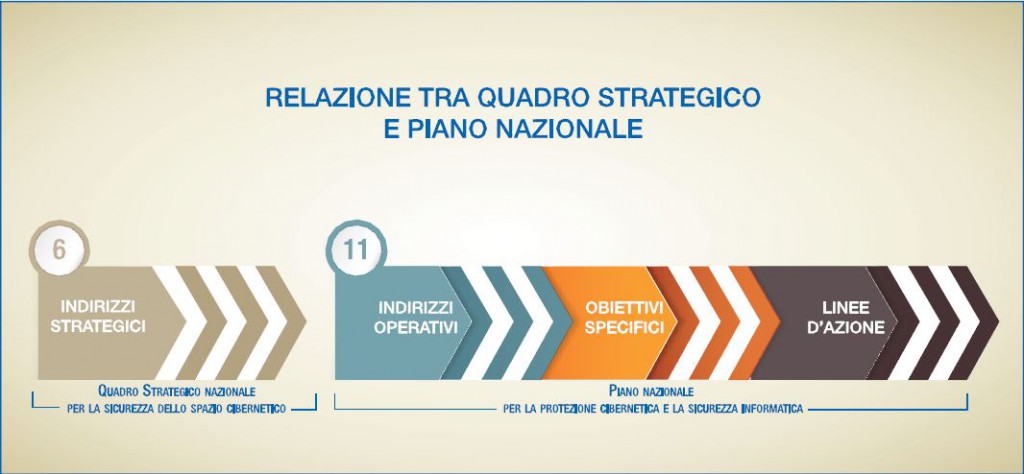
Il modello adottato, se così si può dire, è quello classico, c.d. “integrato”. In cima alla piramide, con compiti di direzione politico-strategica, sono il Presidente del Consiglio ed i ministri del CISR ai quali spetta la formulazione del “quadro strategico nazionale per la sicurezza dello spazio cibernetico” e del “Piano nazionale per la protezione cibernetica e la sicurezza informatica nazionali”. Leggendo le definizioni che di entrambi – quadro strategico e piano nazionale -vengono date nel decreto direi che si tratta, di fatto, della strategia di cyber-security.
A supporto del vertice politico-strategico, in via permanente, vengono collocati un “organismo collegiale di coordinamento” ed un Nucleo per la sicurezza cibernetica. Più precisamente, il primo opera a supporto del CISR, il secondo, istituito all’interno dell’Ufficio del Consigliere militare, opera a supporto del Presidente del Consiglio.
L’organismo collegiale, presieduto dal Direttore generale del DIS, dovrebbe essere il “CISR tecnico” di cui si accenna sia nella relazione annuale del COPASIR che in quella del Governo, istituito lo scorso anno con il DPCM 26 ottobre 2012, n.2.
Il Nucleo, invece, viene istituito con l’attuale provvedimento ed è, nel campo della prevenzione e della preparazione a crisi cibernetiche, lo strumento di raccordo ed integrazione tra le varie amministrazioni e gli uffici con competenza. E’ presieduto dal Consigliere militare ed è composto da rappresentanti delle principali amministrazioni, compresa la Protezione Civile. Ha a disposizione un’unità di allertamento che opera senza soluzione di continuità e tra i suoi compiti vi è quello di attivare il Tavolo interministeriale di crisi cibernetica nel caso in un evento cibernetico sia ritenuto tale da mettere in pericolo la sicurezza nazionale o richieda comunque un coordinamento interministeriale. Sarà poi compito del Tavolo, presieduto dal Consigliere militare, garantire il coordinamento nella gestione della crisi, avvalendosi anche dal CERT (che, peraltro, non mi risulta essere stato ancora istituito).

L’Intelligence, in linea con le proprie competenze ed attribuzioni, provvede ad assicurare la raccolta informativa, le analisi strategiche e le previsioni in materia di sicurezza cibernetica. Centrale il ruolo del DIS. Non solo, infatti, il suo Direttore presiede l’organismo collegiale di coordinamento, principale supporto del CISR e cinghia di trasmissione tra vertice politico-strategico e singole amministrazioni, ma all’interno della Scuola di formazione il decreto istituisce anche un comitato scientifico composto da esperti del mondo accademico, della pubblica amministrazione e del settore privato con il compito di “formulare ipotesi di intervento rivolte a migliorare gli standard ed i livelli di sicurezza dei sistemi e delle reti“.

Il DPCM, infine, contiene le definizioni di “spazio cibernetico“, “sicurezza cibernetica“, “minaccia cibernetica” ed “evento cibernetico“. Se non erro è la prima volta che tali termini vengono formalmente definiti all’interno di un testo legislativo italiano.

19 marzo 2013 - 11:32 pm | by | 17 Comments »
Tags: , , .

Il cyber-terrorismo, questo sconosciuto

mar
19


L’Università britannica di Swansea dal 2011 ha attivo un programma di studio denominato “Cyberterrorism Project” nell’ambito del quale, tra le altre cose, è stato effettuato un sondaggio sul “cyber-terrorismo”.
Tra giugno e novembre dello scorso anno a circa 600 esperti internazionali è stato sottoposto un questionario (i cui risultati sono aggregati nel documento allegato). Hanno risposto in 118, in gran parte ricercatori, di 24 nazioni (due italiani). Il 50% con una formazione politologica (Scienze Politiche, Relazioni Internazionali), il 15% con una formazione psicologica/antropologica, il 12% con un background ingegneristico, l’11% con una formazione giuridica.
Il sondaggio – a mio avviso ottimo – conferma quanto già percepito da chi opera nel settore soprattutto per quanto riguarda termini e definizioni.
Manca, ad esempio, una definizione condivisa di “cyber-terrorism” (dal 58% considerato una seria minaccia) benchè la maggioranza degli intervistati la ritenga essenziale o comunque molto importante. Sussiste, invece, un certo accordo sugli elementi essenziali di un attacco di ciberterrorismo: motivazione politico-ideologica (87%), strumenti o target digitali (77%), terrore come conseguenza dell’azione (70%).
Riguardo alla terminologia adottata – e nonostante la gran varietà di termini indichi, a mio avviso, un po’ di confusione – “cyberwarfare”, “information warfare” e “cybercrime” sono le parole preferite e più adoperate dagli esperti intervistati.

Una nota finale. Il campione si divide esattamente a metà quando viene chiesto se un atto di cyber-terrorismo ha già avuto luogo o meno. Il 49% risponde di sì ed un altro 49% risponde di no. Forse sbaglierò ma proprio questo dato è indicativo della confusione che, almeno per adesso, regna nel settore.
Dimenticavo, dei 55 esperti che ritengono che un atto di terrorismo cyber abbia già avuto luogo 11 lo identificano con gli attacchi all’Estonia, 6 con Stuxnet, 3 con gli attacchi alla Georgia.


Cyberterrorism: a survey of researchers

19 marzo 2013 - 11:20 am | by | 1 Comment »
Tags: .

L’edizione 2013 del Forum di Bruxelles

mar
17


Si è appena conclusa a Bruxelles l’annuale forum transatlantico organizzato dal German Marshall Fund.
Tra le diverse sessioni open (alcune, infatti, sono off the record) ho trovato particolarmente interessanti quella dedicata all’indipendenza energetica statunitense, quella sulla partnership economica tra Stati Uniti ed Europa, quella sul futuro del potere in Cina e, soprattutto, quella nella quale Christopher A. Kojm, chairman del NIC, ha presentato i risultati del Global Trends 2030.
Per chi fosse interessato sono disponibili i video e le trascrizioni degli interventi di tutte le sessioni aperte.

17 marzo 2013 - 11:28 pm | by | No Comments »
Tags: , , , , .

Il futuro della guerra

mar
06


Per il terzo anno Foreign Policy ha effettuato un sondaggio sul futuro della guerra interpellando una settantina di esperti statunitensi i quali hanno risposto sui principali temi strategici: dallo stato di Al Qaeda alla competizione con la Cina in Asia, dalla crisi siriana alle primavere arabe, dai droni al cyberwarfare fino ai problemi connessi con le riduzioni nel bilancio della Difesa.

6 marzo 2013 - 10:00 am | by | 2 Comments »
Tags: , , , , .

Le operazioni cyber cinesi, la deterrenza ed il rapporto Mandiant

feb
25


Il solito, bravo e ben informato, David Sanger ha pubblicato un articolo sul New York Times dal quale tra le righe traspare, a mio modesto avviso, l’effettivo ruolo del governo americano nel recente rapporto della Mandiant e, più in generale, la sua strategia di contrasto nei confronti del cyber-spionaggio “made in China”:

When the Obama administration circulated to the nation’s Internet providers last week a lengthy confidential list of computer addresses linked to a hacking group that has stolen terabytes of data from American corporations, it left out one crucial fact: that nearly every one of the digital addresses could be traced to the neighborhood in Shanghai that is headquarters to the Chinese military’s cybercommand. That deliberate omission underscored the heightened sensitivities inside the Obama administration over just how directly to confront China’s untested new leadership over the hacking issue, as the administration escalates demands that China halt the state-sponsored attacks that Beijing insists it is not mounting.[...]
Defining “enemies” in this case is not always an easy task. China is not an outright foe of the United States, the way the Soviet Union once was; rather, China is both an economic competitor and a crucial supplier and customer. The two countries traded $425 billion in goods last year, and China remains, despite many diplomatic tensions, a critical financier of American debt. As Hillary Rodham Clinton put it to Australia’s prime minister in 2009 on her way to visit China for the first time as secretary of state, “How do you deal toughly with your banker?” In the case of the evidence that the People’s Liberation Army is probably the force behind “Comment Crew,” the biggest of roughly 20 hacking groups that American intelligence agencies follow, the answer is that the United States is being highly circumspect. Administration officials were perfectly happy to have Mandiant, a private security firm, issue the report tracing the cyberattacks to the door of China’s cybercommand; American officials said privately that they had no problems with Mandiant’s conclusions, but they did not want to say so on the record. That explains why China went unmentioned as the location of the suspect servers in the warning to Internet providers. “We were told that directly embarrassing the Chinese would backfire,” one intelligence official said. “It would only make them more defensive, and more nationalistic.”[...]
In the next few months, American officials say, there will be many private warnings delivered by Washington to Chinese leaders, including Xi Jinping, who will soon assume China’s presidency. Both Tom Donilon, the national security adviser, and Mrs. Clinton’s successor, John Kerry, have trips to China in the offing. Those private conversations are expected to make a case that the sheer size and sophistication of the attacks over the past few years threaten to erode support for China among the country’s biggest allies in Washington, the American business community.

In altre parole, sempre secondo il sottoscritto, Washington – tramite la “copertura” (più o meno consapevole) di società private (in questo caso la Mandiant) e senza esporsi ufficialmente – indica il governo cinese come vero responsabile delle operazioni cyber a danno delle aziende americane. Ciò sia a fini di consenso interno (policy di cyber-security) che nell’ambito di un dialogo con la stessa Pechino.

25 febbraio 2013 - 10:00 am | by | 1 Comment »
Tags: , , .